Frequently Asked Questions

Who Uses NeuronsVR
Which aged care groups use NeuronsVR?
NeuronsVR VR therapy programs are used by aged care groups across Australia and New Zealand, including Ozcare across Queensland, Southern Cross Care (NSW & ACT) across NSW and the ACT, Amana Living in every one of its homes in Western Australia, and Lutheran Homes Barossa in South Australia. A NeuronsVR therapy session takes place every 2.2 minutes.
How often is NeuronsVR used?
A NeuronsVR therapy session takes place every 2.2 minutes across aged care in Australia and New Zealand. Teams keep using it long after rollout because it is built into care plans and everyday practice.
Is NeuronsVR used across whole aged care groups, or just single homes?
Both, and increasingly across whole groups. Ozcare uses NeuronsVR therapy across its Queensland residential aged care homes. Southern Cross Care (NSW & ACT) is rolling it out across its homes in NSW and the ACT as part of clinical governance. Amana Living has NeuronsVR therapy within every home. Lifestyle teams, nurses and carers all use it every day.
Can I do what NeuronsVR does with my own headset and videos?
A consumer headset can play 360-degree video, but it does not deliver NeuronsVR therapy. NeuronsVR programs are clinically developed for people living with dementia, with defined session structure, pacing and content designed around clinical goals. Generic 360-degree video is not designed for this population, and content that is too fast, too intense or unfamiliar may cause distress, confusion or disorientation. NeuronsVR also gives care teams session guidance and a way to document outcomes for care plans and accreditation, which consumer apps do not. If you are caring for someone at home, speak with their clinician before using any VR, and contact us to discuss a supported program.
About the Technology
What is NeuronsVR?
NeuronsVR delivers clinically developed therapy programs built specifically for aged care and hospital settings. Includes pre-configured equipment, Therapy Library, and all the training, support and reporting your team needs to provide non-pharmacological care.
NeuronsVR was developed for clinical environments, not adapted from a consumer product. Every program is designed and built in-house by our clinical team, with the clinical goal set first and the experience built around it.The person receiving care sits at the centre of that process, from the first design decision to the finished session.
Does it require an internet connection?
No, NeuronsVR headsets operate entirely offline. This means sessions run reliably regardless of your facility's Wi-Fi coverage, and there is no ongoing data usage or bandwidth requirement.
Do residents need to hold a controller?
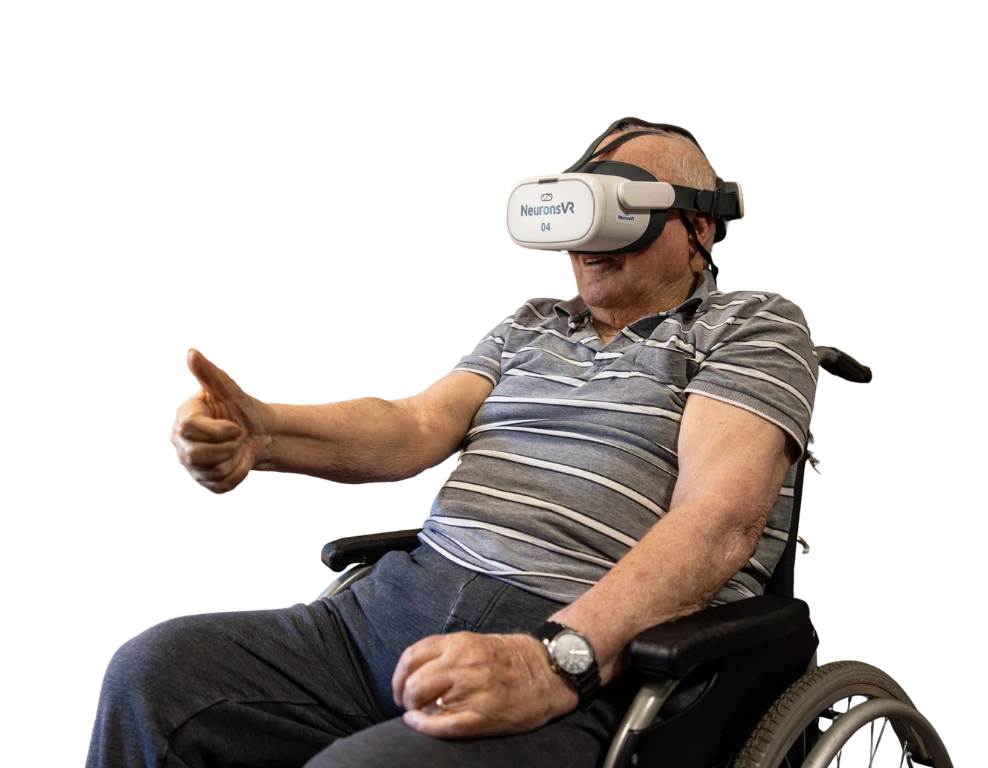
NeuronsVR uses controller-free navigation. Residents simply put on the headset and look around. This is particularly important for people living with dementia or residents with limited mobility or dexterity. There is nothing to hold, press, or learn.
What if a resident cannot wear a headset?
NeuronsVR headsets are designed to suit the majority of users. The headsets are size adjustable and compatible with glasses and hearing aids.
Where a physical or clinical concern is present, the session can be mirrored to a tablet or screen. The resident takes part in the same program without wearing anything.
How heavy is the headset?
The headset is lightweight, balanced and specially designed for aged care, making it ideal for session lengths of typically 5-15 minutes. It adjusts to fit comfortably over glasses and is compatiable with hearing aids.
What happens if the headset is dropped or damaged?
NeuronsVR provides free ongoing support, care teams will not be left managing hardware issues on their own.
NeuronsVR
Use Applications
Can NeuronsVR be used for people living with dementia?
NeuronsVR programs are specifically developed for dementia care, with experiences clinically screened to minimise sensory triggers associated with vertigo, motion sickness and epilepsy. NeuronsVR therapy can reduce agitation and support people experiencing changed behaviours associated with dementia (BPSD)
Is NeuronsVR suitable for palliative and end-of-life care?
NeuronsVR is used in palliative care settings to support comfort, relaxation and emotional wellbeing at end of life. These programs are used alongside standard palliative care to help reduce distress and support a sense of peace, especially for those experiencing existential crisis at end of life.
Is NeuronsVR a non-pharmacological alternative to managing distress?
NeuronsVR is a non-pharmacological therapy tool used to support residents experiencing distress, anxiety or agitation. It may be used as part of broader care strategies aimed at reducing reliance on chemical restraint, alongside clinical judgement and existing care plans.
Is NeuronsVR suitable for culturally diverse and spiritual care?
Yes, NeuronsVR includes culturally relevant and spiritually meaningful experiences that can support CALD care, spiritual wellbeing and identity-based connection. This aligns with trauma-informed and person-centred care approaches.
We tried VR before and residents did not engage with it. Why would this be different?
This is one of the most common concerns we hear. Consumer VR content is designed for younger adults. It is fast-moving, complex, and often overwhelming for older adults or people living with dementia. NeuronsVR programs are developed specifically for this population: gentle, familiar, and clinically structured. The headset design also removes the hand controller barrier that causes most first-session failures with general-purpose VR.
Is NeuronsVR suitable for lifestyle and group programs?
Yes. Lifestyle teams use NeuronsVR for group social sessions and individual therapy. The program library includes world tours, travel programs and bucket-list experiences from major cities across the globe, alongside clinically developed dementia therapy programs.
Does NeuronsVR support culturally and linguistically diverse (CALD) residents?
Yes. Culturally specific programs are available in multiple languages. NeuronsVR can also develop programs in a specific language on request, so residents engage in a language and cultural context that is familiar to them.
Can we request therapy programs from NeuronsVR?
Yes. NeuronsVR develops custom programs on request for your site, including culturally specific programs in multiple languages.
How does NeuronsVR measure whether a program is working?
Resident tracking tools record engagement during each session. After the session, therapeutic indicators help clinical and lifestyle staff judge whether the program is right for that person.
Using NeuronsVR in Your Facility
Who runs the sessions?
Any trained staff member. Lifestyle coordinators, OTs, RNs, and care staff can all run sessions. NeuronsVR does not require specialist technical knowledge. The technology is simple and designed to be used at any time by anyone.
How long does a session take?
Session setup takes under a minute. Sessions themselves typically run between 5 and 20 minutes, depending on the resident's needs, preferences, and care plan. Your staff control the session length.
Can NeuronsVR be used for group sessions?
NeuronsVR works in both one-to-one and group settings. For group sessions, content can be mirrored to a screen or TV so multiple residents can experience the same program together, even if only one resident is wearing the headset.
How can VR Therapy fit into our existing lifestyle schedule?
NeuronsVR integrates seamlessly into existing activity programs. Sessions can be scheduled within the lifestyle calendar and supported by multisensory engagement activities accompanying each therapy experience, delivered one-to-one as needed, or used by nursing staff during clinical care such as wound treatment.
Clinical Evidence
Is there clinical evidence that VR therapy works for people living with dementia?
NeuronsVR has conducted and participated in peer-reviewed clinical trials examining outcomes including agitation reduction, quality of life, and staff usability. Results have been published in peer-reviewed journals and registered with ANZCTR. You can view the full clinical evidence on our research page.
Which therapy techniques does NeuronsVR use?
Programs are built on established therapeutic approaches, including reminiscence, sensory stimulation, cognitive engagement, movement, relaxation, de-escalation, cultural connection, and visual and auditory de-stimulation. Each approach is matched to individual needs, with engagement and outcomes documented. Visit our Therapy Techniques pages to understand the clinical rationale behind each approach.
Can the outcomes be documented for care plans and accreditation?
Yes, NeuronsVR outcomes are documented by staff as part of standard care plan records, the same way any other therapy activity is recorded. The documented engagement data supports reporting for quality indicators and ACQSC accreditation reviews.
Pricing and Packages
Is NeuronsVR sold to the public?
No, we only sell to Nursing homes and hospitals direct.
How do we purchase?
The equipment & staff education is available for an upfront purchase. The Library of Therapy Experiences is available on a subscription.
How much does NeuronsVR cost?
We do not advertise pricing, because the right package depends on your facility. Your care settings and the kit you need shape the quote. Larger facilities may need more headsets or a larger kit, so size is a guide to the right kit, not a charge. NeuronsVR is not charged per session, per resident or per bed. Book a demo and we will recommend the right kit for your setting.
Are there different packages for different care settings?
NeuronsVR offers a wheeled case for residential facilities and a compact case designed for hospice and homecare settings. Both include the full program library. See the packages page for a full comparison.
Do you offer multi-site pricing?
If you manage more than one facility, or would like to implement across multiple areas of care contact us to discuss a coordinated rollout and multi-site pricing options.
Implementation and Support
What does onboarding look like?
When your kit arrives, a NeuronsVR specialist provides on-site training for your lifestyle, occupational therapy, clinical and care teams. Training covers headset operation, program selection, session delivery, care plan documentation, and implementation across clinical care and dementia, staff can run sessions independently from day one.
Is there an extra charge for staff training?
No, on site in person training is essential to proper implementation and is no extra charge to the facility.
What ongoing support do we receive?
NeuronsVR provides ongoing support for the life of your subscription. This includes a direct point of contact for questions, hardware support, content updates, and access to any new programs added to the library.
Is the content library updated?
New programs are added to the NeuronsVR library regularly.
How long does it take until we receive or order?
1 to 2 weeks.
Why do services continue using NeuronsVR after initial rollout?
Services continue using NeuronsVR because it is practical to implement, acceptable to residents, and adaptable to a wide range of care contexts including dementia support, palliative care and culturally responsive care. Ongoing use is reflected in sustained session frequency across multiple facilities.
Compliance and Accreditation
Does NeuronsVR support compliance with the Aged Care Quality Standards?
Yes. NeuronsVR supports strengthened Standards, including person-centred care, dignity and choice, meaningful engagement, dementia support, non-pharmacological strategies and the minimisation of restrictive practices. Documented therapy sessions can contribute evidence of individualised care, engagement and outcomes during accreditation reviews.
Read further on the Residential Aged Care page.
Is NeuronsVR relevant to the new Aged Care Act (2024)?
Yes, the new Act places greater emphasis on measurable, reportable quality of life outcomes for residents. NeuronsVR provides a non-pharmacological therapy tool with documented, evidence-based outcomes that can be used to demonstrate compliance and resident-centred care.
Does NeuronsVR hold ISO certification?
NeuronsVR is certified by Environmental Management System ISO 14001:2015, Quality Management System ISO 9001:2015 and Safety Management System ISO 45001:2018.
— Can't find what you're after?
Still have questions?
Get in touch with any questions you have that aren't covered on this page.