
The Evidence That Numbers Can't Capture
When residents engage with NeuronsVR and experience a true magic moment, the numbers and statistics become insignificant. Watch some of our captured experiences below.
FEATURED STORY
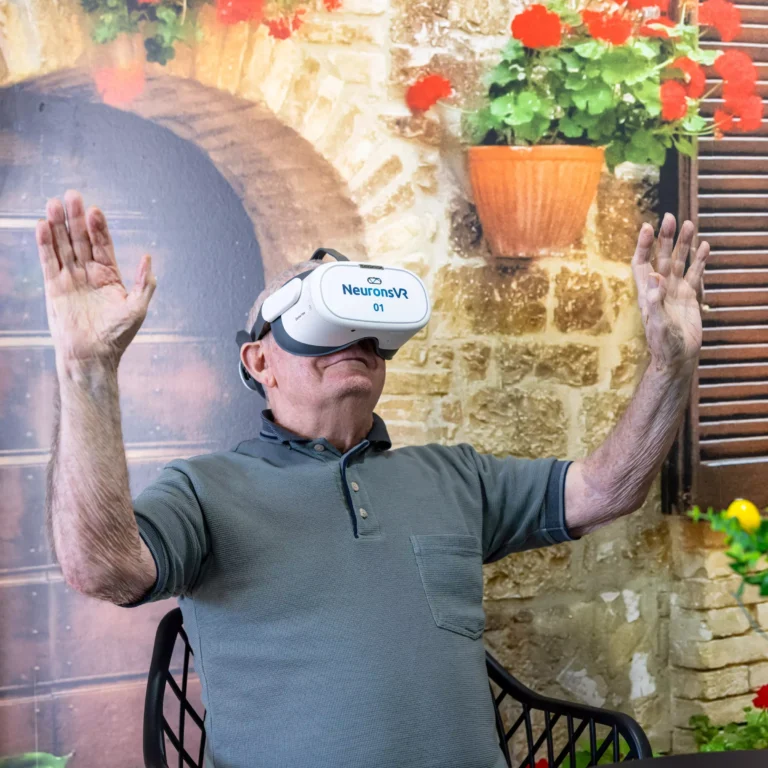
Behind the changed behaviour, there was only ever an unmet need. He wasn't a bad guy, he just wanted to go home.
—— Changing Behaviours with NeuronsVR
The Resident Nobody Could Reach
George was 68. After 19 SIRS reports in seven months, his aged care home was questioning whether it could continue supporting him. Staff struggled to engage with him and believed he would never accept a headset.
We knew George was born in Greece, so we took him back to Santorini. He became completely still and watched the entire experience without saying a word. When it ended, he began sharing memories of an island boot maker and his first pair of leather shoes.
George had grown up as an orphan and was apprenticed to that boot maker. Nobody at the home had ever heard his story because nobody had been able to sit with him long enough to hear it.
Our advice was simple: when George becomes distressed, take him back to Santorini. Months later, he remained in his home, more settled, while staff continued to “take him home every single day.”
**Who could NeuronsVR help you reconnect with?**
—— Real Life Magic Moments
Every Moment is a Real Session
Well that was 10 out of 10!
Moyne Health, VIC
I was running in the surf!
Palliative care unit, VIC
I just saw back to my young days.
Regional aged care, QLD
I've Been to Edinburgh Castle
Residential Aged Care, NSW
That was just fantastic! I want a hug
Dementia care wing
Mamma Mia! Transported back in time
Residential Aged Care, NT
It brings back the memories
Residential Aged Care, NSW
I was absolutely right in it.
Residential Aged Care
Smiles with VR therapy
Residential Aged Care
—— How It Runs
Built to Integrate Into Existing Care Systems.
Memory Support
Memory Support
Using familiar places, sounds and scenes to support memory recall, conversation and emotional recognition. The most widely used context across residential aged care.
PALLIATIVE CARE
Palliative & End-of-Life Care
Non-pharmacological comfort and distraction for residents in palliative settings. VR provides meaningful sensory experience when physical mobility is limited.
CULTURAL CONNECTION
Cultural Connection
Experiences from culturally significant places across the world, including First Nations libraries throughout the Northern Territory supporting multiculturally appropriate engagement and care.
CHANGED BEHAVIOUR
Changed Behaviour Support
Structured sensory engagement as an alternative to PRN medication during episodes of agitation, sundowning and distress. Documented, timestamped, auditable.
Social Connection
Social Connection
Social Engagement between staff and residents, fostering a sense of community and connection in care.
FAMILY CONNECTION
Family Connection
Shared experiences between residents and visiting family members. A structured activity that creates conversation, reduces isolation and supports family relationships.
—— What the Research Says
Grounded in Clinical research
Our work is evaluated through peer-reviewed studies, ANZCTR-registered clinical trials, and active partnerships with the University of Technology Sydney. The evidence isn't a marketing line. It's the foundation.
10+
Years of peer-reviewed research
NeuronsVR's therapy model is built on over a decade of published studies on VR-based reminiscence therapy and non-pharmacological dementia care.
ANZCTR-registered clinical trials
UTS
University of Technology Sydney partnership
Active research partnership with UTS evaluating outcomes across residential aged care and hospital settings in Australia.
University of Technology Sydney
82%
Reduced agitation in clinical trial settings
82% of participants in structured reminiscence VR sessions showed measurable reduction in agitation markers compared to control conditions.
Published clinical outcomes, 2019-2024
—— Scenes in Our Library
Endless Places To Go Back To
REMINISCENCE
Sydney Harbour Ferry
A familiar commute designed to support reminiscence, conversation and recognition.
SENSORY
Underwater Reef
Slow, immersive visuals used to reduce agitation and support self-regulation.
REMINISCENCE
A Country Church
A calm, familiar setting that can prompt memory, ritual and emotional grounding.
FIRST NATIONS
Uluru
Country scenes co-designed with First Nations communities, supporting cultural recognition and belonging.
—— Frequently Asked
Questions we hear often
What is NeuronsVR therapy for people living with dementia?
NeuronsVR therapy uses virtual reality to take people living with dementia back to familiar places and experiences, such as a childhood home town, a favourite coastline, or the country they grew up in. Reminiscence therapy itself is one of the most widely studied non-pharmacological approaches in dementia care, with evidence for supporting memory recall, improving mood, reducing agitation, and encouraging social interaction. Delivering it through VR makes the experience immersive and personal: rather than looking at photographs, the person is surrounded by the place itself. In practice, sessions often prompt an "I remember" moment, with residents sharing stories their care teams have never heard. NeuronsVR programs are clinically developed and selected to match each person's life history and cultural background.
How does NeuronsVR work in a residential aged care facility?
A staff member brings the headset to the resident, selects a program, fits the headset and sits with them for the session. There's no dedicated room, no installation and no change to the building. Sessions run wherever the resident already is: their room, a quiet lounge, beside a bed. Programs are pre-loaded on the device, so sessions don't depend on facility wifi. Lifestyle and care staff run it without clinical qualification. Most facilities fold it into existing lifestyle programming rather than adding a new activity block.
Is NeuronsVR therapy safe for people living with dementia?
NeuronsVR programs are developed to be safe for people living with dementia, vastly different to consumer VR, content is vetted to enure it isnt at rick of causing negative triggers such as nausea, motion sickness, vertigo etc. Headsets are lightweight and can be removed instantly by the staff member sitting with the resident. Screen before a first session for photosensitive epilepsy, recent eye surgery, acute delirium or current agitation, and record the resident's response afterwards. Anyone can stop at any point, and stopping is treated as useful information about that resident, not a failure.
Can residents with advanced dementia use NeuronsVR therapy?
Yes, and it's often where the response is strongest. NeuronsVR therapy doesn't rely on language, following instructions or recalling recent events, so it stays available after those abilities decline. The response may be non-verbal: settling, quieter hands, humming, reaching towards the music. Late stage cognitive decline and advanced behaviours are evidenced in the clinical trials and can be viewed on the magic moments page.
Does NeuronsVR work in palliative care settings?
In palliative care the goal shifts from engagement to comfort, rest and connection. Common uses include returning to a place of significance, giving a person something to talk about with visiting family, and offering a break from a room they can no longer leave, and managing existential pain.